
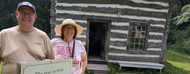
We almost didn’t go. We’ve lived in Wisconsin since 1998 and somehow never made it to Old World Wisconsin. What drew me there was the Scandinavian immigrant history. Since I bought Norsland Lefse in 2024, I’ve been working to learn more about Norwegian and Scandinavian history, and it felt like something I should go see for myself.
The Fossebrekke cabin has a striking story. Knudt Christiansen Fossebrekke left Norway and came to America in 1839. In Wisconsin, he found land but didn’t yet have money to buy it. He lived first in a dugout — basically a shelter in the side of a hill — before building the cabin. Old World Wisconsin interprets the cabin around 1845, and PBS Wisconsin describes it as the oldest historic building at the site.
Fossebrekke supposedly housed 17 people in that small building one winter. We don’t know if that was all at once or folks coming and going. Regardless, it tells you a lot. Early immigrants were not just building houses; they were acting as a survival network for people arriving with little money, little shelter, and no safety net.
Raspberry School was started by three Scandinavian families. The school served children of multiple ages in one room, and those three families shared the responsibility of housing and supporting the teacher who educated them. That kind of arrangement — where neighbors fill in what none of them could do alone — shows up everywhere in the stories at Old World Wisconsin.
What struck me walking through the Scandinavian Homesteads area was how much these families did for themselves, and how much they depended on each other to do it. Women could teach as young as 16. We saw wool that had been dyed from plants grown in a garden right next to where we were standing. The life was hard, but it wasn’t isolated — it was deeply woven together.
While I am not Norwegian, this matters to me. One of the reasons I am passionate about Norsland Lefse is that we are a part of preserving a legacy and heritage. It’s important to learn about the history of the cultures around us, whether they’re ours or someone else’s.
On the 250th birthday of this country, I think this is what’s worth celebrating: people who showed up with almost nothing and built something anyway. It’s also worth sitting with the fuller picture. Before these settlers arrived, this land belonged to the Ho-Chunk, Ojibwe, and other nations — displaced through federal treaties in the decades before. Their history is part of this place too.
If you haven’t been to Old World Wisconsin, I’d encourage you to go. When we were there, we bought a Family Pass through the Wisconsin Historical Society — it includes reciprocal admission benefits through NARM, which I plan to use to visit the Vesterheim Norwegian-American Museum. That’s next on my list.
These stories are worth keeping. That’s why we do what we do.
Explore Norwegian favorites
- Authentic Norwegian Lefse
- Love Scandinavian baking? Stock up on our soft, buttery Kringla Cookies for an authentic Nordic treat any time.
- Bring a taste of Nordic comfort to your daily routine with this Scandinavian Coffee & Kringla Gift Box